By Ana Barbu 鈥�10
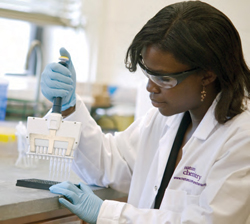
Lendelle Raymond 鈥�12 studied the breast cancer drug Letrozole. |
For many college students, earning money in the summer involves manual or menial labor鈥攎owing lawns, bussing tables, painting houses, and the like. But, thanks to Horace G. McDonell, Jr. 鈥�52, 鈥�02 (Hon.), a former Adelphi Trustee and a retired chairman and CEO of PerkinElmer Inc., a scientific instrument company, seven Adelphi students who are passionate about science spent the听summer of 2011 conducting full-time research for 10 weeks, and getting paid for it.
鈥淭hroughout my career, I have enjoyed the benefits of the four years I spent at Adelphi,鈥� says Mr. McDonell. 鈥淧ut simply, this is my way of paying back part of those benefits.鈥� The purpose of the science fund, according to Mr. McDonell, is to help Adelphi prepare 鈥渁 stream of highly qualified bachelor graduates in the natural sciences, as good as those from the best competing institutions.鈥�
Associate Provost for Administration Lawrence Hobbie, who formerly chaired the Department of Biology, Professor of Chemistry Joseph Landesberg, and Professor and Chair of the Physics Department Gottipaty Rao set the framework for the McDonell Fellowship pilot program. 鈥淲e thought that something that might have the most impact on the students and the faculty was for people to support summer research,鈥� Dr. Hobbie says.
Once the students received the chairs鈥� approvals on project proposals they had developed with their faculty mentors, they immersed themselves in hands-on research and experimentation. 鈥淭he primary goal of the fellowship is to offer intellectual and state-of-the-art training to students,鈥� Dr. Rao says.
|
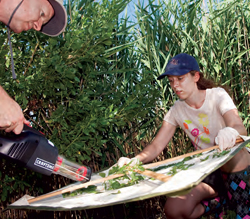
Carolyn Trietsch 鈥�12 with her faculty mentor Assistant Professor of Biology Matthias Foellmer collected insect samples in order to study the impact of heavy metal pollution. |
Each student received a $4,000 research stipend and $1,000 for equipment and research supplies. 鈥淚t鈥檚 very hard to do science on a part-time basis,鈥� Dr. Hobbie says. 鈥淸The fellowship] allows students to do science full-time. When you鈥檙e doing that kind of an intensive experience, you develop a mastery of technique.鈥�
Mijael Damian 鈥�13 collaborated with Associate Professor听of Physics Sean Bentley to study the uncertainty principle, a major principle in quantum mechanics, and the reaction that occurs when sending entangled photons through space and time obstacles. A blue laser passing through a crystal, a prism, and a beam splitter, the latterof which polarized the incoming light, and detectors that provided the number of entangled photons, were part of his experiments. 鈥淸The McDonell Fellowship] is going to help students,鈥� Mr. Damian says. 鈥淪ome…students don鈥檛 get their hands on equipment until their senior year. Even then, they don鈥檛 get to do anything as exciting and fun as this.鈥� Mr. Damian shared the physics lab with Danielle Sofferman 鈥�13, who conducted a nonlinear optics project. 鈥淚t鈥檚 very exciting to be actually doing the research,鈥� she says. 鈥淭o see everything falling together, see how enthusiastic my professor is about it. That鈥檚 inspirational.鈥�
Ililochi Onwuzu 鈥�12 researched nitrogen dioxide concentrations in the environment using a quantum cascade laser-based technique featured in national physics publication, Physics Today, and developed by Dr. Rao and Physics Department Research Coordinator Andreas Karpf. The research is salient to the Environmental Protection Agency and other organizations involved in trace-gas detection, according to Ms. Onwuzu. 鈥淚t鈥檚 a great experience to learn the [research] techniques,鈥� she says. 鈥淚鈥檒l probably need them for different work I鈥檓 going to do in the future,鈥� which may involve alternative energy sources. Meanwhile, physics major Sajan Shrestha 鈥�13 worked on developing sensors to detect industrial improvised explosive devices.
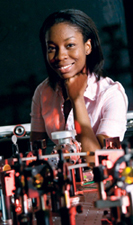
Ililochi Onwuzu 鈥�12 used lasers to study nitrogen dioxide concentrations in the environment. |
Chemistry student Lendelle Raymond 鈥�12, under the guidance of Assistant Professor of Chemistry Melissa Van Alstine, experimented with two enzymes: CYP1A1, which detoxifies environmental carcinogens and is important in the metabolic activation of dietary compounds with cancer-preventive character, and CYP1A2,听which oxidizes structurally dissimilar compounds, including听steroids and fatty acids, according to Ms. Raymond. Her study听entailed finding out whether Letrozole, an inhibitor of CYP19A1听(aromatase) used in the treatment of estrogen-dependent breast听cancer, inhibits the two enzymes. 鈥淔or me, [the most exciting part听of the project] is when you get the data,鈥� she says. 鈥淲hen you see听if the drug Letrozole will inhibit the enzyme, and you get pretty听good results…It鈥檚 fantastic.鈥�
Biology student Carolyn Trietsch 鈥�12, who was mentored by Assistant Professor of Biology Matthias Foellmer, studied food webs in the South Shore salt marshes focusing on wolf spiders, a link between marine and terrestrial food webs. Ms. Trietsch set up traps in Freeport, Oceanside, and Point Lookout and observed insects in the field. She focused on each insect community in the sampling sites to see how their food webs differ and how they are affected by heavy metal pollution. 鈥淚 don鈥檛 have to look for a [summer] job,鈥� she says. 鈥淚 can basically do what I am interested in and still get paid for it.鈥�
Meanwhile, biology student Claire Flynn 鈥�12, under the direction of Assistant Professor of Biology Andrea Ward, continued her research on the two startle responses of South American lungfish to discover why they evolved to perform both responses, while most aquatic species perform one. She implanted six electrodes鈥攖hree on each side of a fish鈥檚 body鈥攚hich translated its muscle reactions to visual records, a process called electromyography. While performing this process on several lungfish, she observed their muscle activation patterns during the two startle responses.
In the fall, the seven students showcased the projects they conducted last summer to help promote their work and the fellowship, according to Dr. Hobbie.
鈥淭his is the best of both worlds because you actually get paid to do your experiments in a research lab,鈥� Dr. Bentley says.
For further information, please contact:
Todd Wilson
Strategic Communications Director听
p 鈥� 516.237.8634
e 鈥� twilson@adelphi.edu